Northbound

The ride to and from Monterey was great: there were lots of critters, birds especially, the scenery was magnificent, and I met some cool people. On the way north, my weather luck ran out, though. I hit some strong headwinds and a bit of rain – no big deal, but the headwinds in particular made for long slow days in the saddle.

wow

I did a bunch of thinking about subjectivity as I rode. First, because I’m really prone to misjudging grades – road sections that look like gradual declines but aren’t, climbs that are way harder or slightly easier than they seem, etc. A lot of it has to do with the surrounding landscape – if everything is going up up up, a road that only goes up a little seems downhill in contrast. And part of it is just that I’m bad at eyeball estimates. Second, I was noticing how much subtle changes in my health and level of rest influence my ride. Coming south, I ate something that disagreed with me and was feeling flat when I pulled in to Plaskett Creek in Big Sur. I’d already decided to take a rest day there and spend a (forecast) rainy day lounging in the tent. I ended up napping for a couple hours around noon, spent the (actual) partly cloudy afternoon wandering around the beach with Lotte, and slept an additional 11 hours that night. The ride TO Plaskett was OK, but a bit of a slog; the ride FROM Plasket was an absolute joy. I had a tailwind, my legs felt great and I was in Morro Bay before i knew it. There are objective realities underpinning my experiences, but I’m struck by how being out in the world and using your body for motive power internalizes those factors in a way that other modes of travel don’t.

And that is what counts as deeeeep thought as I pedal along. *embarrassed face* Travelogue below the fold!
Continue reading

Kelp

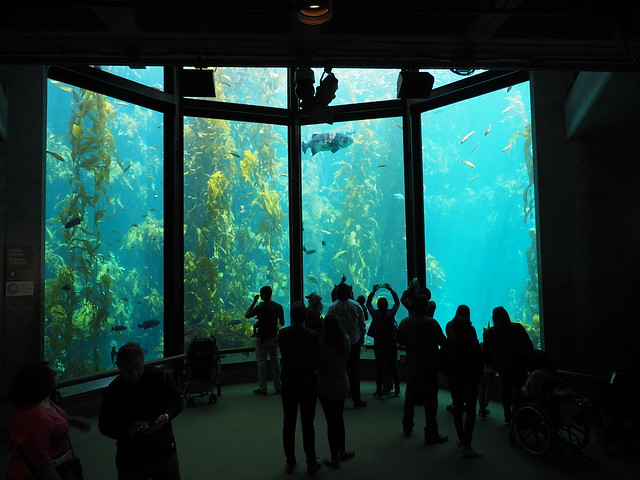
Since my last post I’ve done a bit more riding: up the California coast to Monterey and back to Los Angeles. I’ll post the travelogue in a bit; right now I’m going to focus on the reason for my ride, namely, the Monterey Bay Aquarium. Everyone I know who’s visited the Aquarium has raved about it and seeing what all the talk was about was  a priority. I spent 2 ‘rest’ days in Monterey at the aquarium – I knew that I’d be overwhelmed after 4 or 5 hours and knew there was more that 4 hours worth of things to see.

Wednesday was ‘get acquainted’ day. I dropped Lotte at doggy day care, cycled back to the motel, dropped the bike and walked through Cannery Row to the aquarium. It was fantastic. Multiple large tanks, each focusing on a specific habitat, great exhibits on cephalopods and Baja California, just great stuff.

Kelp forest tank

The kelp forest tank.

The deep reef from above

The deep reef from above.

The top of the kelp forest tank.

A tank full of Lookdowns.

Not all the action was indoors. From the sea-side balconies I saw sea otters in the kelp and a sea lion preying on what an Aquarium volunteer guessed was a young adult Mola mola. As I expected, I was used up about four and a half hours in, so I walked back to my room, mounted up and retrieved the pup.

The next day started the same way, but a little bit later, because I was scheduled to take a behind the scenes tour at 2:30. Going behind the scenes was great – we saw the food prep area, the veterinary suite and the top of one of the large tanks.

Fridge

Just like my fridge!

Necropsy lab

Necropsy area

Reef tanks top

Service balcony at the top of the deep reef.

One of the coolest things I learned on the tour, though, has to do with the orange buoy shaped object in the photo below. It’s a pig.

pig!

The Monterey Bay Aquarium uses seawater from the bay for many of the tanks (all of the big tanks, I think?). The water is filtered during the day to ensure good visibility in the displays, but gets pumped in raw at night. As a result, there’s been a lot of colonization – algae, sea stars, etc, coming in as plankton and growing out in the tanks. What folks didn’t anticipate was that the same thing would happen in the seawater intake pipes; it did. The Aquarium needs to pig the pipes every couple weeks to keep them flowing freely! I don’t know why I find the whole thing delightful, but I do.

An excellent visit to a great aquarium! It moved ‘learn to dive’ way up on my priority list – I want to swim through the kelp forest!

Nányóu Jì

-or-

Journey to the South

I posted earlier about my encounter with macaws in the context of Mimbres culture and how it seemed to offer a framework to structure a New Mexico to Chihuahua bike ride around. I’ve spent the morning reading RITUAL CHANGE AND THE DISTANT: MESOAMERICAN ICONOGRAPHY, SCARLET MACAWS, AND GREAT KIVAS IN THE MIMBRES REGION OF SOUTHWESTERN NEW MEXICO and 1) my mind is blown and 2) it’s an incredible framework and needs to be a longer ride.

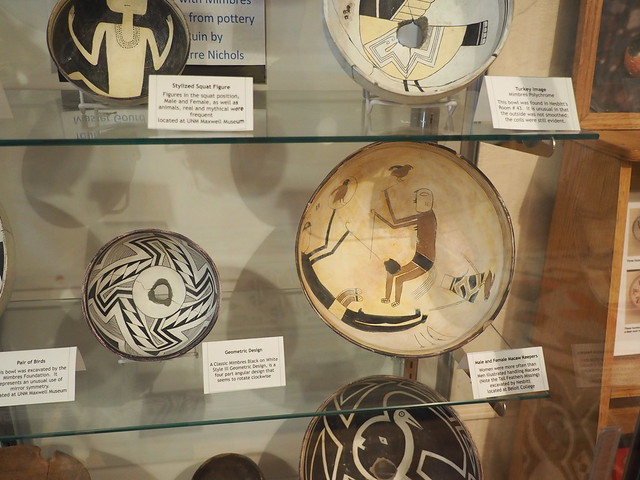
Mimbres macaw bowl

Enlarge the photo and check out the bowl with the macaws and people – note the info on the tag!

The paper argues, well, I’ll let them say it…

Additional points:

  • given that women are most often depicted handling macaws, was this a woman’s quest to the south?
  • I was thinking trade routes, but trade – perhaps turquoise for birds or something similar- may not have been the point. It may have been about esoteric knowledge and the birds that symbolized it with nothing given in exchange except religious alleigance.
  • the Hopi have a story of Tiyo, who journeyed south and returned with ritual knowledge of the Snake Dance – another case of ‘listen to what the people tell you about their history’?

I’n going to keep investigating , but this is exciting stuff! And for those who didn’t recognize it immediately, the title is a riff on Journey to the West. “The novel is an extended account of the legendary pilgrimage of the Tang dynasty Buddhist monk Xuanzang who traveled to the “Western Regions”, that is, Central Asia and India, to obtain Buddhist sacred texts (sutras) and returned after many trials and much suffering.”* Appropriate, I think.

L.A. River Camp Coffee and the Canning Stock Route

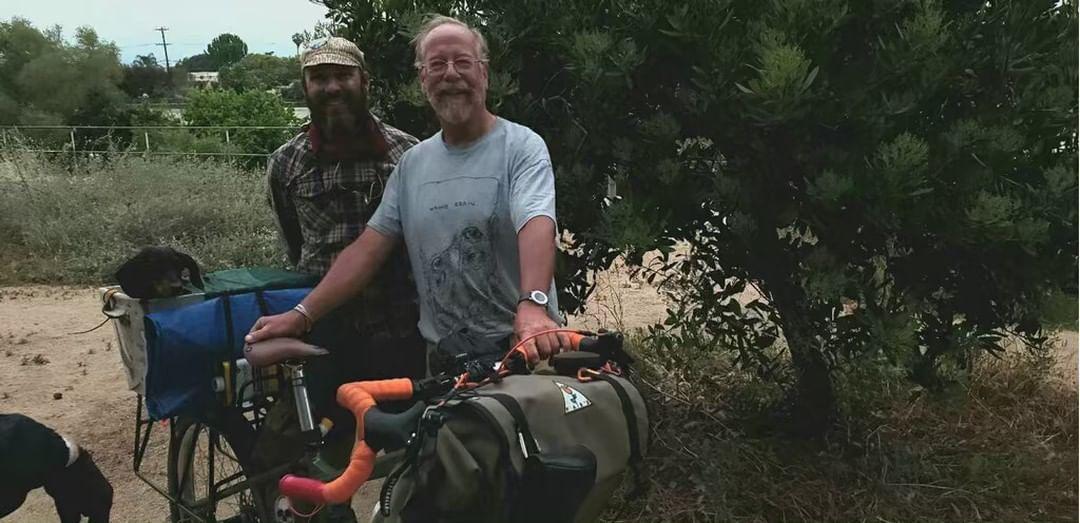
I first had coffee outside with the L.A. River Camp Coffee crew a couple years ago while out on a visit and doing it again was a priority this time, given that I’d legit biked into town. By way of explanation, LARCC is an informal group of cyclists, organized originally by Errin Vasquez, who meet at a small park on the L.A. River bike path to brew coffee and shoot the breeze – my kind of group! First thing Wednesday morning, I put Lotte in her basket and pedaled 5 miles north to meet the group. It was – no surprise – a ton of fun and there was lots of interesting bike talk.

#adventureteckel at L.A. River Camp Coffee!

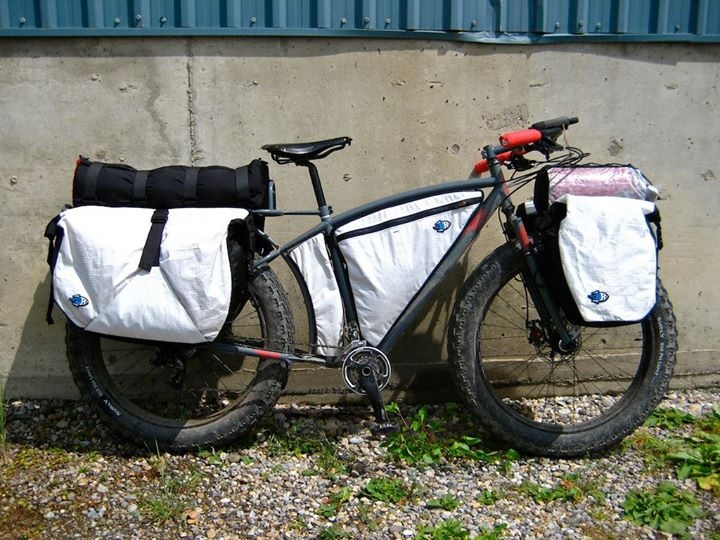
Errin and I were talking about Molly Fin (the bike) and frame materials; I said something about a steel mid-tail being a dream machine and he filled me in on the ur-midtail – the bike that inspired the Salsa Blackborow. In 2013, Rick Hunter built a bike for Scott Felter (bagmaker/Porcelain Rocket). Not just any bike, obviously, but a mid-tail fat bike for a ride along Austrailia’s Canning Stock Route. More on the route in a minute, but check out this bike!!!!

Lots of cargo capacity, not because Scott planned to take an #adventureteckel with him, but because the route requires that folks ride with 30-35 days of food and 4-5 days of water. If you want to read about the ride, Tom Walwyn’s blog is the place to start; he has a great Flickr album, too.

20130801-Dune descent 1

I’d never heard of the Canning Stock Route, so I googled it up. It’s clearly a tangent I’m going to spend some time reading about. I’ll quote from Wikipedia:

The Canning Stock Route is a track that runs from Halls Creek in the Kimberley region of Western Australia to Wiluna in the mid-west region. With a total distance of around 1,850 km (1,150 mi) it is the longest historic stock route in the world.

The stock route was proposed as a way of breaking a monopoly that west Kimberley cattlemen had on the beef trade at the beginning of the 20th century. In 1906, the Government of Western Australia appointed Alfred Canning to survey the route. When the survey party returned to Perth, Canning’s treatment of Aboriginal guides came under scrutiny leading to a Royal Commission. Canning had been organising Aboriginal hunts to show the explorer where the waterholes were. Despite condemning Canning’s methods, the Royal Commission, after the Lord Mayor of Perth, Alexander Forrest had appeared as a witness for Canning, exonerated Canning and his men of all charges. The cook who made the complaints was dismissed and Canning was sent back to finish the job.

I’m especially interested in the Royal Commission and the cook, Edward Blake. I wonder if my initial take – that for things to have risen to Royal Commission level, the accusations were serious – is indeed correct. I’ve got no background in Australian history, so no context to judge against; looks like an opportunity for me to learn. Thank you, Errin, for exciting my curiosity!