Rattus norvegicus

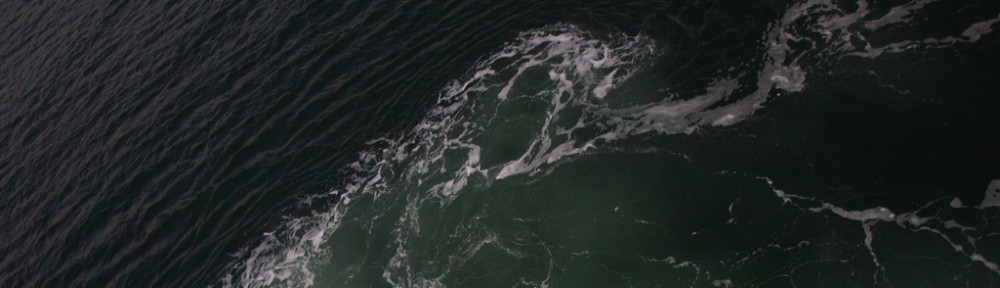
Rats are fascinating. A few species of rat have colonized niches provided by agrarian and industrial human societies; I blogged earlier in the year about the Polynesian rat and Easter Island – now it’s the wharf rat (my favorite name for R. norvegicus) and England’s turn. So… here’s a rat-catcher’s link farm:

…the only advantage to the mongoose being that all the Rats it kills it will bring back dead to it’s habitation, and that stops the dead Rats from smelling under the floors.

*

*

Update (11/29) – a great post on Patrick Burn’s site – R. norvegicus prevents plague!

Site outages

Occasionally you may have trouble getting at my blog. I host the site myself – at home – so when the power goes out for a while, or my cable goes out or any number of other things happen -> the blog goes dark. Keep checking – sooner or later I’ll be back.

The DoaMNH technical mini-FAQ:

Q: Why host the site yourself?

A: Um… seemed like a good idea at the time? Actually, I like the feeling of accomplishment I get – additionally, throwing WordPress software on the server I was already running was not a big deal.

Q:Why is it slow?

A: Because US broadband providers don’t get it. They think of residential customers as consumers – passive web surfers – rather than folks who both use and produce info. Bandwidth inbound (from the web to me) is approx. 8Mb/s; outbound (my blog to your browser) is about 750 Kb/s.

Q: So what are you running?

A: From the bottom up:

  • Mini-ITX based server (low power consumption) – VIA EPIA SP13000 mobo w/ 512M of RAM and 2 120Gb SATA drives. Parts from Logic Supply.
  • SME Server Version 7 – a great, easy to use Linux server distribution. It’s absolutely perfect for a home server.
  • WordPress 2.x blogging software with a bunch of plug-ins.

Probably more than you wanted to know.

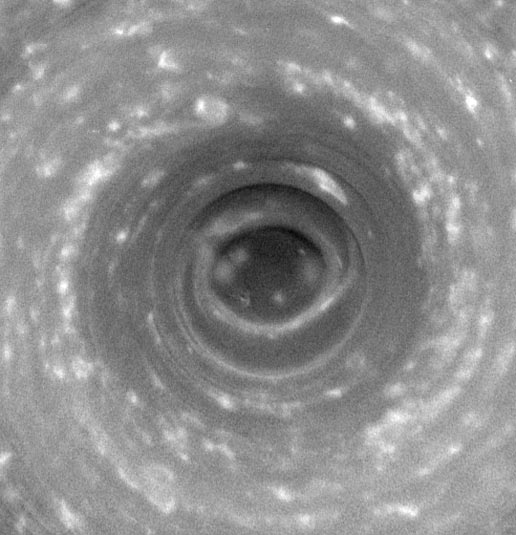
Storm at Saturn’s south pole

This doesn’t need any comment from me…

A movie taken by Cassini’s camera over a three-hour period reveals winds around Saturn’s south pole blowing clockwise at 550 kilometers (350 miles) per hour. The camera also saw the shadow cast by a ring of towering clouds surrounding the pole, and two spiral arms of clouds extending from the central ring. These ring clouds, 30 to 75 kilometers (20 to 45 miles) above those in the center of the storm, are two to five times taller than the clouds of thunderstorms and hurricanes on Earth.

Eye-wall clouds are a distinguishing feature of hurricanes on Earth. They form where moist air flows inward across the ocean’s surface, rising vertically and releasing a heavy rain around an interior circle of descending air that is the eye of the storm itself. Though it is uncertain whether such moist convection is driving Saturn’s storm, the dark “eye” at the pole, the eye-wall clouds and the spiral arms together indicate a hurricane-like system. *