*
*

Via Wired.
The complete mitochondrial DNA genome of an unknown hominin from southern Siberia : Nature.
Here we report a complete mitochondrial (mt) DNA sequence retrieved from a bone excavated in 2008 in Denisova Cave in the Altai Mountains in southern Siberia. It represents a hitherto unknown type of hominin mtDNA that shares a common ancestor with anatomically modern human and Neanderthal mtDNAs about 1.0 million years ago. This indicates that it derives from a hominin migration out of Africa distinct from that of the ancestors of Neanderthals and of modern humans. The stratigraphy of the cave where the bone was found suggests that the Denisova hominin lived close in time and space with Neanderthals as well as with modern humans.
Hobbit version 2.0: the undiscovered hominin
As my students have heard me say many, many times, gene trees are not species trees. The different genetic loci within a population have diverse genealogies. Often, when two populations diverge from each other, their gene genealogies will show similar patterns of divergence. But not always.
When we look within a single population, gene genealogies are likewise diverse. but within a single population, there is no population divergence. There must be an oldest branch point in the genealogy of any single gene. Here’s a question: how many individuals do you have to sample so that you are sure you will find this deepest branch point? The answer to that question depends on the frequencies of the lineages on either side of that branch. If one of them happens to be rare, you’re unlikely to find it unless you sample lots and lots of individuals.
And if the population is spread across a substantial amount of space, it is very likely that one of the clades will be geographically limited compared to the other.
Put these two things together, and apply them to a widespread population like the Neandertals. It is pretty likely that if we sample a dozen Neandertals across a subset of their range, that we will miss the deepest divergence in the genealogy of a single gene. That may be what has happened here. By extending the known mitochondrial sample of Neandertals even further to the east, this study may have discovered a deeper branch point than was previously known within the Neandertal population.
Indeed, a million-year-old clade divergence would be entirely normal for a large mammal. That’s what we see in chimpanzees, and as I pointed out yesterday, it’s smaller than the clade divergence we see among mammoth mtDNA across a similar time range and geographic extent.
By necessity, these women are public/historic – I’ll add to the list as I see ’em:
I first met Angela at a New Hampshire Media Makers meetup back in August 2009. During her three minute ‘here’s what I’m up to’ presentation she spoke of her interest in wearable tech: fabric/electronic mashups. I’m interested in any kind of computing/networking/digital tech that doesn’t involve a screen, keyboard and beige box; we said hello and struck up a conversation. Later in the week, she sent me links to work – REACTIVEfashion – she’d done (with Rebecca Grabman) as a senior at Bennington:
Interactive Formalwear.

*
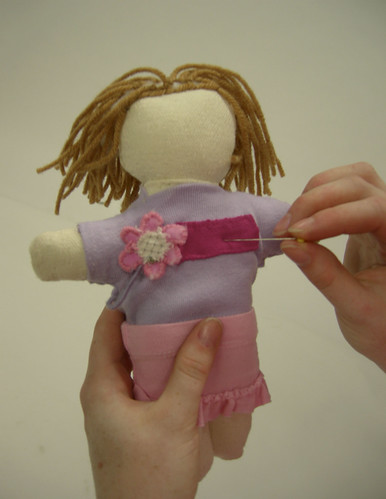
Tween Voodoo.
*
Skate Power.

*
Wow, said I.
Before we get to what Angela has been up to recently, a few words on the path she took into Making. She went to Bennington intending to paint and do illustration, but ended up in a 3D animation class. When the person teaching 3D animation left, that program was essentially done (perils of small colleges). Not to worry – Angela jumped into Robert Ransick’s Viral Media class, from there, on to Physical Computing. Her timing was perfect – Leah Beuchley was off and running on her pioneering work, the Arduino folks had produced their platform (since adapted/adopted into the wearable-friendly Lilypad) – there was a lot of fun and ferment around wearables. Her interest in physical computing led to the work above, which was presented in a couple different venues – including a runway show, and to a class that I have to mention because the title is so great: Experiments in Mixed Reality (incidentally, structured around rapid prototyping cycles).
Since I met her last fall, Angela has been producing great work at an amazing clip:
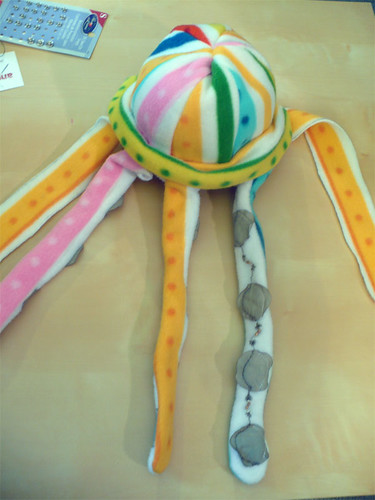
I’m probably missing a couple, too. Going forward, I’ve heard rumblings that she’s coordinating flash-mob fun (including interactive tech) with Tara Sullivan (organizer of the Portsmouth Thriller Dance last Halloween) and know for sure that she’s looking into makerspace possibilities here on the seacoast. Especially with the flash-mob planning, it seems that she’s exploring some of the group dynamics/interaction themes that were central to at least one of the rapid-prototype projects she’s described to me.
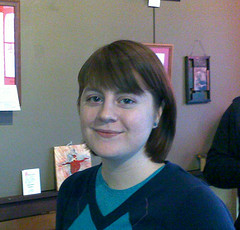
Why Angela Sheehan on Ada Lovelace Day? She epitomizes, for me, many of the best aspects of Maker kulturny. She mashes up things she’s skilled at with things she’s figuring out and isn’t daunted by ‘I’ve never done that before’. If it’s something she wants to know, she learns it; if it’s less intriguing, she’ll get help. She pulls stuff apart and repurposes components in service to her projects. Alongside the uber-maker thing is her creativity – Angela just has a ton of cool ideas, many of which involve technology (important for the whole Lovelace thing!). Three cheers for Ada Lovelace and three cheers for Angela Sheehan.
[Side note – you can find Angela’s chinchilla related work at The Fuzz Depot.]