Something a little different – a match on two categories of technology for reasons that are pretty abstract. Ladies and gentlemen, I give you… the shotgun and the bicycle. Bear with me – I think a case can be made.
Near-platonic simplicity. Lightness is important for both – more so, perhaps for the bicycle, which could weigh nothing and not effect performance – for the shotgun, some weight damps recoil. The general unwillingness of folks to carry/pedal around extra ounces leads to a paring away that leaves just enough gun/bike to get the job done. On a good bike or shotgun, everything there is necessary; all parts contribute and integrate.
*
Fit. Shotguns are not so much aimed as they are pointed. When you put the gun to your shoulder, you want it to be in the same place every time and you want your head positioned so that you are looking down the length of the barrels consistently. If the gun is oriented slightly differently every time you mount it (stop giggling – that’s the right phrase), it doesn’t matter how well you swing through – you’ll miss more often than I do (in other words, lots). If you are looking to minimize wasted energy, fit is important on a bicycle. You can pedal a bike in a lot of different positions, but if the idea is to translate your effort into forward progress, you’ve got to pay attention to the saddle/pedal relationship. I can’t think of two other things (and I’m including clothing) that benefit more from a good body-object match.

*
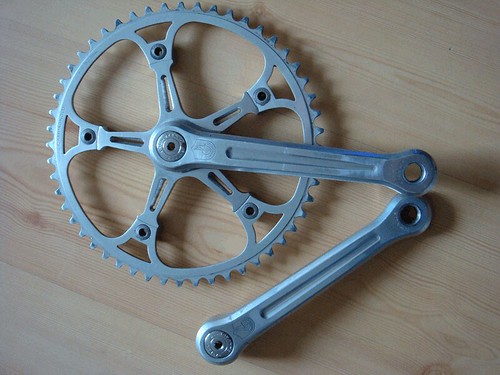
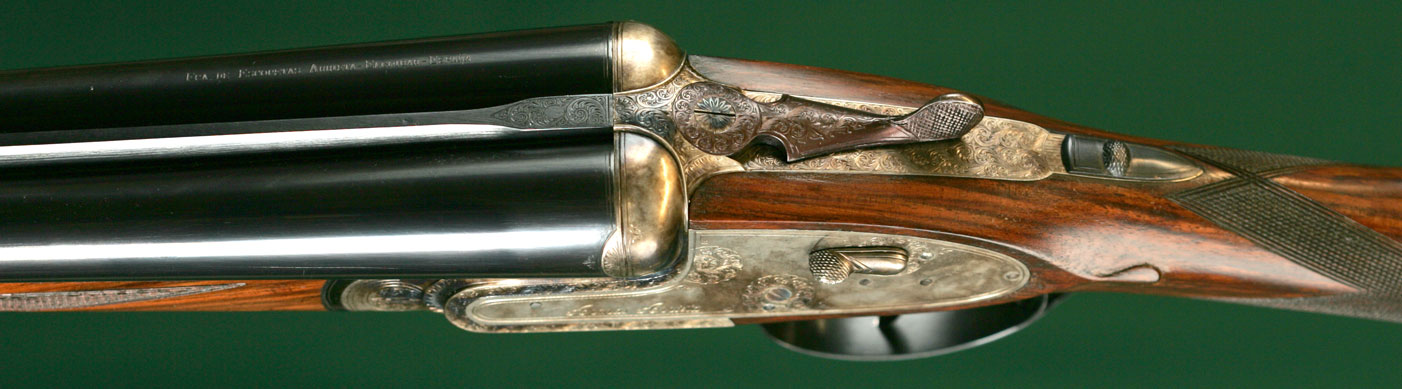
Decorative elements. Somewhat in tension with point 1, but within the tight constraints of weight and function – and often augmenting the effort on both in an artistic way – is the human urge to decorate and add meaning thereby. Color case hardening (shotgun), pantographing (bicycle), engraving (shotgun), lugwork (bicycle), choice of wood (shotgun), drilling out (bicycle) – all, when done well, enhance the object. On a personal note, I’m nuts for color case work. My ideal would be a sidelock with a tiny amount of engraving around the edges of the sideplate and any screws and the rest bare save for an oil slick of case hardening (and gold-washed inside, where no one can see, but where it will help prevent corrosion).

*
*
Made by people. At the high end (where the similarities are most apparent), there are craftspeople involved – brazing, filing, carving, drilling. It shows, again, both in form and function.
I’ve had this little set of arguments (“bike and shotgun, why do I like thee so much? let me count the ways.”) floating around in my head for years. It’s getting attention now because of a recent post on Knucklebuster. Seems there was an American motorcycle manufacturer named Merkel.

*
Way back when, bicycle and motorcycle (and aircraft) technology bled into each other pretty seamlessly. Shotgun lovers will also recognize the name – not the same company, but there is a famous German shotgun maker also named Merkel.
So – here’s thought 1. Since old motorcycles shared a lot of elements in common with bicycles – what would be cooler than a board track-ish moped? Small motor in that U-shaped down tube, pedals well positioned, brass tank with ‘Flying Merkel’ lettered in green paint and gold leaf. Design student – we need to talk.
Thought 2 – perfect pairing with the slightly greater complexity of the Flying Merkel moped? A Merkel 96k drilling (that’s a side-by-side shotgun with a rifle barrel tucked underneath, usually) in 12ga x 12ga x .30/06. Dinah running along side, the little teckel that I hope to get this spring tucked in a saddlebag or in my coat – jaeger, jaeger, über alles.