creatures


Cross-posted to LibraryThing. N.b. – I’m reviewing an ARC – nitpicks may not apply to the final product.

I approached Jessica Speart’s Winged Obsession with a bit of trepidation; the last butterfly book I read (which covered some of the same territory) was a bust, to say the least. My initial impression was less than positive. Whatever good things there are to say about the book – and there are good things – Ms. Speart’s writing style is not among them. I don’t require end-to-end lyricism, but I felt as if I were reading something pitched at a supermarket checkout line level. Page 5:

He took it all in as he studied one booth after the next. He wasn’t there for the bugs, and though he got a kick out of seeing movie stars, they weren’t his prey du jour either. He glanced down at the photo in his hand. It was a legal resident-alien driver’s license gratis the California Department of Motor Vehicles. His prey was an Asian man who was a notorious bug collector. It was time to make the donuts and find his quarry.

My discomfort increased when, on page 74, she asserts that, “Operation Falcon exposed a Middle Eastern plot to smuggle endangered wild falcons from North America for the sport of sheiks and oil-rich falconers.” Um, no. I think it would be more accurate to say something like “Operation Falcon exposed the gullibility of USF&W as they were played like a cheap fiddle by a con man who entrapped just enough other folk to keep one step ahead of the game and it killed many wild falcons especially on the back end, when F&W was responsible for caring for confiscated birds.” I was a bit of a skeptic going in – the narrative is clearly ‘heroic law enforcement officer’ – errors like this deepened my skepticism; the phrase that leaps to minds is ‘drinking the (USF&W) kool-aid’.

With all that said, the last third of the book held me spellbound as Ed Newcomer, the USF&W agent, was running Yoshi Kojima to ground. Kojima is a very strange man, but is no dummy – an expert smuggler. Real tension gets built as Newcomer gets closer and closer… At the same time Newcomer is working the California roller pigeon case (Op. High Roller -most of my falconry friends will be familiar w/ the case already) and is having some marriage trouble. We get a wrap-up of the pigeon case, but there’s no resolution (that the reader is privy to) on the home front.

Overall, I’d give this 2 1/2 stars – down from 3 because of the writing style and kool-aid quaffing.

Separately – because it’s not a fair knock on Ms. Speart’s work – I wish the book had veered a bit into some of the conservation issues it brushes up against. At one point, we see a facility that breeds endangered California butterflies; release areas are a huge issue, so the facility has oodles of dead adults they can’t do anything with. The question of what do you do with this kind of material is a big one with no good answer. In the US, the answer is nothing. In Europe – at least in the cases I’m familiar with – the answer may be different. When smuggled dart frogs are confiscated on their way into the EU, they are often later released to hobbyists. This puts frogs into the hands of folks who will hopefully breed them and may save them from being destroyed, but also allows ‘laundering’. In the US, it’s pretty clear, based on export permits, CITES paperwork, etc. what species were imported legally. It’s a lot fuzzier across the water – as soon as confiscated Dendrobates unobtaniatus are released, all instances of same already in country magically become offspring of the released one. The thorny issue of wildlife monetization pops up as well – one side says that by making wildlife valuable (esp to the locals), habitat will be preserved. The other side sees dollar value as a fast road to decimation – the best way to increase value is to make the item rare (the deBeers strategy). Finally, I would have loved some analysis of the hidden bad guy in the butterfly smuggling story – the Japanese government. Do they just not care? Have they been captured by the smugglers on this issue? Is there anything non-Japanese citizens can do?

“Our laws are very important, or Congress wouldn’t have saddled us with them. [...]“, retired FWS agent Terry Grosz sadly declared.

Wow. Naive/idealistic/crazy?


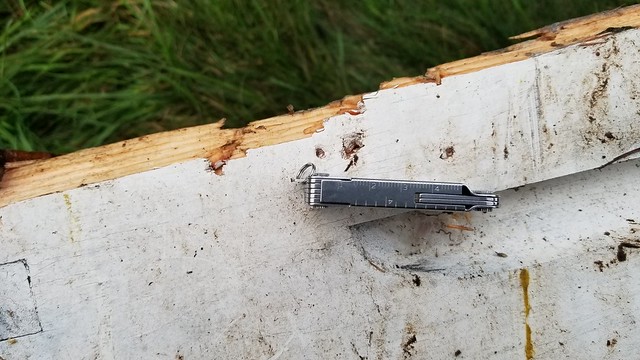
My across-the-hall science teacher partner in thoughtcrime has a bag of tricks that would make Felix green with envy. Today, he reached in and a microphonograph and a deck of Audible Audubon cards appeared. The Microsonic microphonograph uses a fixed platter/record and rotates the tonearm.

Microphonograph

*

*

Manual pages can be found here, here and here.

The Audible Audubon are a series of cards – one per species. On one side there is a picture of the bird; on the other, a brief narrative description and a clear record.

Microphonograph & Audible Audubon

*

Put the card in the microphonograph and out come calls!

*

A nice little bit of late-70′s tech and a reminder of how much more available info is now that it’s digitally encoded in semi-standardized ways (see Sibley and Audubon iOS apps).


I heard about this clip today at Discover Wild New Hampshire Day. White Faced Ibis are uncommon in New England – to see an Ibis predated by a Peregrine and to be rolling tape at the same time? Buy a lottery ticket. I’m with the guy who says, “Can somebody else be really excited about this?”

“Mike Blust’s ornithology class from Green Mountain College, Poultney, VT, gets to see white-faced ibis (rare in Massachusetts) and the realities of nature. The falcon itself had a damaged left eye. It had been making passes at the ibis for about 10 minutes before this happened.”

At last Sunday’s NH Media Makers meetup, @spyboy turned me on to the 360 Panorama iOS app. It stitches in real time as you pan and uses the accelerometer to control panning when you display the photo. Way fun! Here’s the wunderkammer end of the classroom across the hall.

KPK Pano

*

Update – here’s a link to the spinny version.

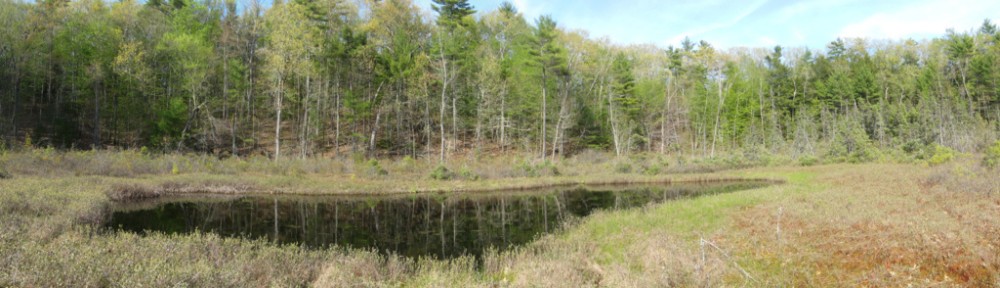
Update II – pano taken during a lunchtime walk to a local bog here.


More often than seems reasonable/random, the internet zeitgeist throws a number of seemingly unrelated references to an interesting topic my way. Today’s theme was robots; a couple weeks ago it was butterflies. The title of the post comes from a tweet from @debcha, “I often describe dragonflies and butterflies as the ‘charismatic megafauna’ of the insect world…” This post will be light on Odonata; expect loads of Lepidoptera.

First up, a book I had high hopes for: The Dangerous World of Butterflies, The Startling Subculture of Criminals, Collectors, and Conservationists.  Short version – I was disappointed. I found the book to be superficial, not very well written and more than a little narcissistic. I don’t know appreciably more about butterflies or butterfly conservation issues than I did before I picked the book up – there didn’t seem to be a thread tying things together or even relating one vignette to another (I’m thinking of Sy Montgomery’s Birdology as a polar opposite). There were tangents that I would have liked to have seen pursued: Laufer touches on the internal mechanisms of metamorphosis and moves on quickly saying, in effect, “it’s an area scientists are still investigating.” Interview a few more scientists? Try to do some science writing? The writing itself is a bit of an issue. It’s published by Lyons Press – if this is the current incarnation of Nick Lyons’ operation, I’m saddened. “And in a box padded with wads of tissue paper for padding…” Ouch. “Item: ‘Take the Lunesta 7-Night Challenge,’ offers an advertisement for a sleeping pill. A floating butterfly illustrates the ad.” The Lunesta (hmm, what might the root word be?) mascot is a large green night-flying lepidopteran. I wouldn’t give Laufer (and the Lyons editors) so much grief but a couple pages earlier he dismisses the other fliers, “I was not seeking dragonflies or even moths. My target was butterflies.” The situation is made even worse by the “Item:” immediately preceding, which mentions -wait for it- a Luna Moth! Sorry. Thumbs down.

*

Next on the bookshelf, Klea McKenna’s The Butterfly Hunter. Klea’s father, Terrence, collected butterflies in Southeast Asia and South America in the late 60′s and early 70′s.  The few words and many beautiful images in this book do much to illuminate the desire and the remorse of the hunter. Highly recommended – and Terrence deserves a series of posts as well.

*

*

*

From the emotional, we move to the practical. Way back at the beginning of the Lepidopteran info storm, @debcha twote a link to Mechanisms of structural colour in the Morpho butterfly. I remember reading a bit about Morpho color a long time ago in The Splendor of Iridescence, but it was a long time ago and retention is an issue. The linked article is technical, but interesting nevertheless.  There’s a cool interplay between structure and underlying color going on in a Morpho‘s wing – makes me want to watch some flutter about.

A side note – I think this xkcd applies pretty well to me (and @debcha thinks it might accurately characterize her as well).

*

And I’ll close out this already overlong post (tl;dr) with some amazing work. I’ve seen some of Paul Schmookler’s butterfly and full-dress Atlantic salmon fly pieces in person and they are stunning.

“An extraordinary display of butterfly and fly by Paul Schmookler, thought by many who have viewed this gifted American artist’s work to be the king of the ‘extreme’ full-dressed salmon fly. Measuring 17 1/2″ x 13″ overall, the gold painted wood frame houses two sunken mounts, the upper with an actual vibrant green/black Trogonoptera brookiana butterfly, a species native to Malaysia, and the lower, a striking 3 1/8″ salmon fly with corresponding colors. The remarkable fly is an original creation of Schmookler’s, tied for the consignor’s collection. In excellent condition throughout, signed on the bottom right. A rare opportunity to own an example of Schmookler’s genius with feather and thread, as this master tyer’s work seldom comes to auction.”

*

*

And one more fly – not butterfly-linked, but I can’t resist.

Two follow-up items…

The storm on Saturn (the mid-latitude one, not the hexagonal one at the pole) has grown and and acquired a nickname – The Serpent Storm.  A couple great pics ganked from here:

*

*

And a new piece of art from Solongo Mellecker – a favorite cryptid, the Mongolian Deathworm. For those not familiar with the worms, the artist’s description, “[the] Mongolian death worm, known as “olgoi horhoi” in Mongolian, meaning large intestine worm, is a snake like creature believed to exist in the Gobi Desert of Mongolia. The worm is a bright red creature, resembling a blood filled intestine, is about 2 to 5 feet long. It can rise from the sand without warning and kill a prey big as a camel.” Tremors critters, eat your (multiple?) hearts out.

Let’s combine  two recent themes: internet-as-connection-engine and internet-as-repository-of-just-about-anything-imaginable! Last night Wesley Fleming favorited some of my photographs of the Blaschka’s work; as I always do, I backtracked to see what sorts of things he’d posted to Flickr. Turns out he’s an amazing lampworker himself. I don’t know why it never occurred to me that folks were still making lampworked representations of nature – my ex (among many artistic talents) made beautiful lampwork beads. I’ll put it down to the impossibility  of successfully thinking from a fire hose; there’s so much cool stuff going on that keeping up with all of it just ain’t going to happen.

Some of Mr. Fleming’s work:

We’ll start with a favorite – a leafcutter ant (timely, too – there’s been a link to a leafcutter nest casting and excavation making the rounds).

Atta (leafcutter ant)

*

Japanese Hornet.

Vespa mandarinia (Japanese hornet)

*

And a variety of stag beetle that’s, as far as I know, new to science, Lucanus alces – the Moose Beetle.

Lucanus alces (moose beetle)

*

It strikes me that thumbnail dart frogs might make good lampwork subjects. Quite a few of them have a very shiny, almost metallic, body color with dark spots or blotches seeming to float above in a separate layer.

The Internet is, among other things, a massive connection engine. I’ve made some great random connections following links around – some clicktrails I’ve managed to remember, some leave me scratching my head and grinning. The link to Sarah Jovan got established via Lord Whimsy’s live journal and an indication of interest in carnivorous plants. Regardless how tenuous the connection, there’s something in all of us (especially strong in me, perhaps) that loves to jump up and down and yell, “Hey! I (kinda/internet) know that person!”:

*

The commensalism in the title?  Lichens are a symbiosis of fungus and algae. For Sarah, my favorite lichen (because my mum taught me it’s common name when I was about 8 or 9) – a Cladonia, too:

British Soldier Cladonia cristatella

I would like one of each – I’d even go for kit form. Assembling them myself would be a blast.

Laggania

*

Dunkleosteus

*

Speculative sea monster

*

Monster fish

*

Via @cephalopodcast.

With longer days things are getting more active. My Phragmipedium caudatum has 10 buds distributed across 3 spikes, the frogs are having a ball and I’m busy planning a bog garden (to be put in after the ground thaws a bit – it’s still jackhammer time out there).

Amereega pepperi male transporting tadpoles (will embiggen maximally when clicked.

*

Nepenthes truncata Paisan Highlands

I opted for Nature on PBS rather than the Grammys the other night – it seemed a reasonable choice for a nature geek. How was I to know that Lady Gaga would reveal that her parents were monotremes? I’ll leave the venomous spur speculation to the internet tabloids… Seriously, the Nature pick was a good one; the episode was “The Himalayas” and it featured quite a few favorites of mine: Mt. Kailas – the axis mundi, Temminck’s tragopan, takin, big rivers in deep gorges, and rhododendrons. It also introduced me to something I was unfamiliar with – aeolian biomes.  To quote L. W. Swan who coined the term (and who seems to have been a major, though as far as I can tell, uncredited influence on this Nature ep), “…I had discovered something that was beyond and quite different to what was called the alpine region, or alpine tundra, the zone of the highest life. This was a new zone, a zone based on atmospheric nutrients, a zone of the wind. I would eventually call it the Aeolian Biome.” * I’ll embed the relevant chapter from Swan’s Tales of the Himalaya – he describes the history of high altitude spiders better than I ever could (and he was there for important pieces of it).

*

I can’t resist pulling another quote – it’s the naturalist’s version of turtles all the way down. “When queried on this subject, Hingston, presumably when he was in his least lucid mood, vaguely suggested that the spiders may eat other spiders.”

The relevant Nature segment:

Watch the full episode. See more Nature.

*

And the whole show (tragopan display at 42:00 or so):

Watch the full episode. See more Nature.

*

Euophrys omnisuperstes and tachikoma – love the resemblance.

Euophrys omnisuperstes.

Tachikoma.

Wunderkammeriffic!

Via @microecos.

« Previous PageNext Page »