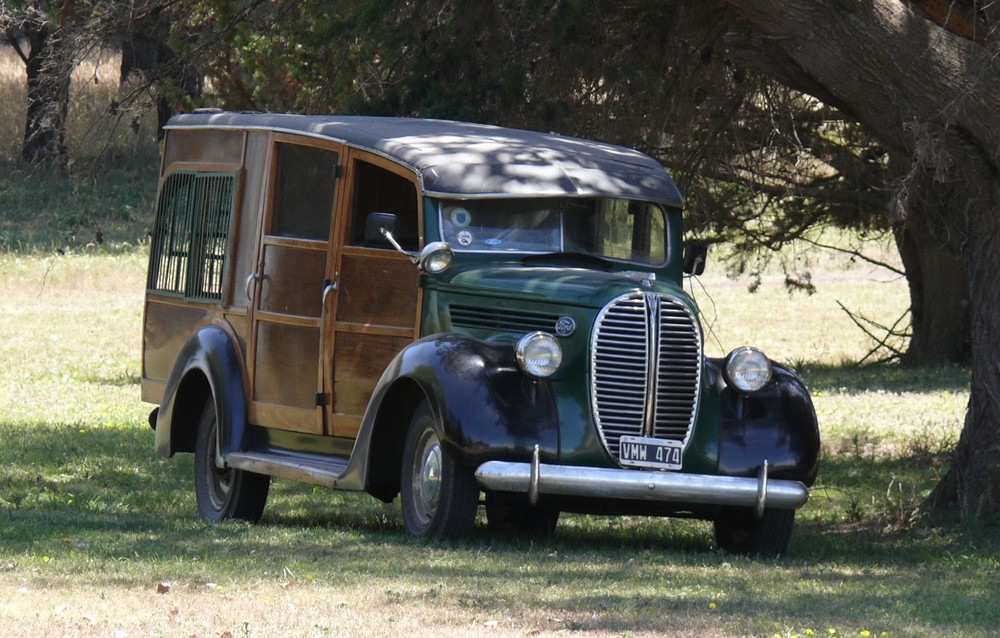
All it needs is a cadge for the longwings and it’d be good to go. Who am I kidding? I’d drive it as is and be very happy.
*
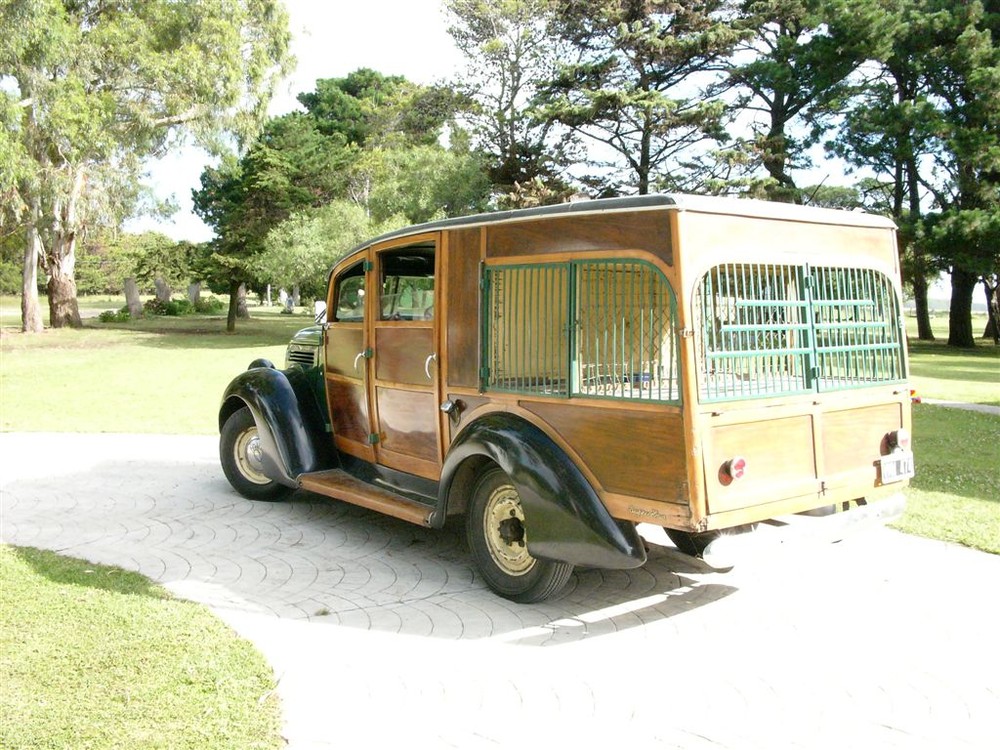
Carro de cacería mayor: An Argentine barn find hunting Ford at Hemmings Blog.
All it needs is a cadge for the longwings and it’d be good to go. Who am I kidding? I’d drive it as is and be very happy.
*
Carro de cacería mayor: An Argentine barn find hunting Ford at Hemmings Blog.
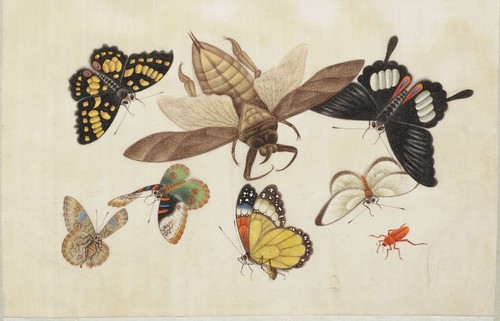
First, let me acknowledge peacay as undisputed champion of Internet cool-stuff-finding. Today’s Butterfly Album post is a multi-dimensional winner. First, there are the images. I’m particularly partial to a painting containing what I think is a Giant Water Bug:
*
Then there’s the intriguing info on where the insects were collected:
The only other information known is that the butterflies and insects were collected from the Aralia (spikenard) and related Tetrapanax papyrifera (pith paper tree) plant species.
Followed by a link to the Harvard Herbarium for more info on the pith paper tree. The Herbarium rates a big marker pin on my mental map – it’s close, houses the Blaschka’s glass plant models and – most important for me – was the base of operations for Richard Evans Schultes (prev. posts here and here). I’ve wandered around the Herbarium website before, but today – thanks to peacay – I kicked around the Botany Library On-Line Exhibits (not sure I’ve ever happened upon this part of the site before). There’s a nice series on book covers/bindings:
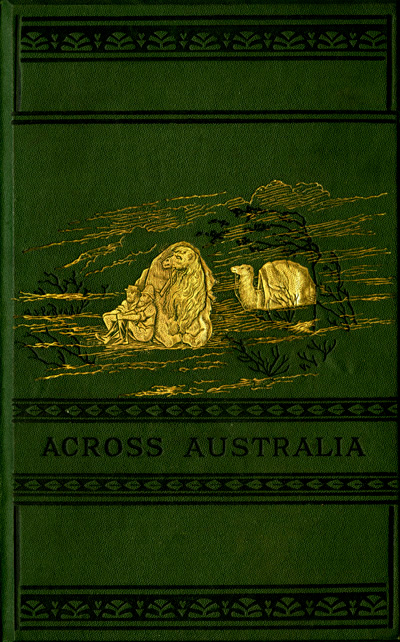
*
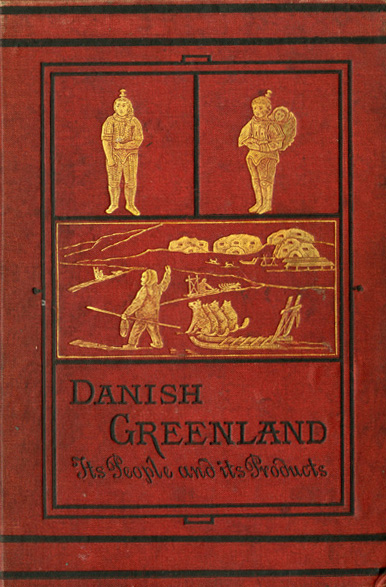
*
a section on the ‘other’ Amanita (phalloides)
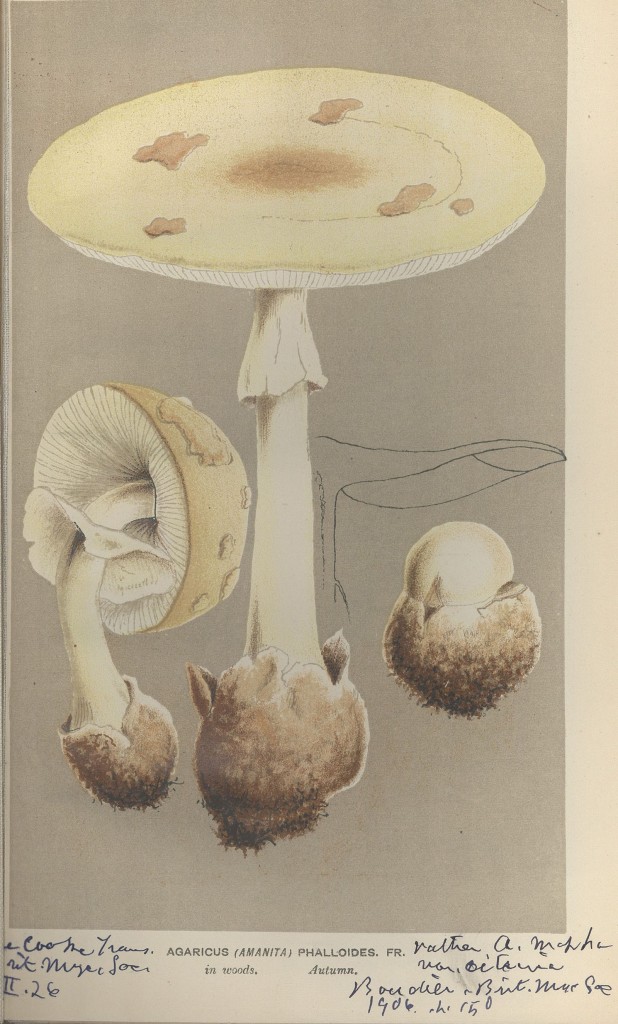
*
and then there’s this, from the Economic Botany Clipping File:
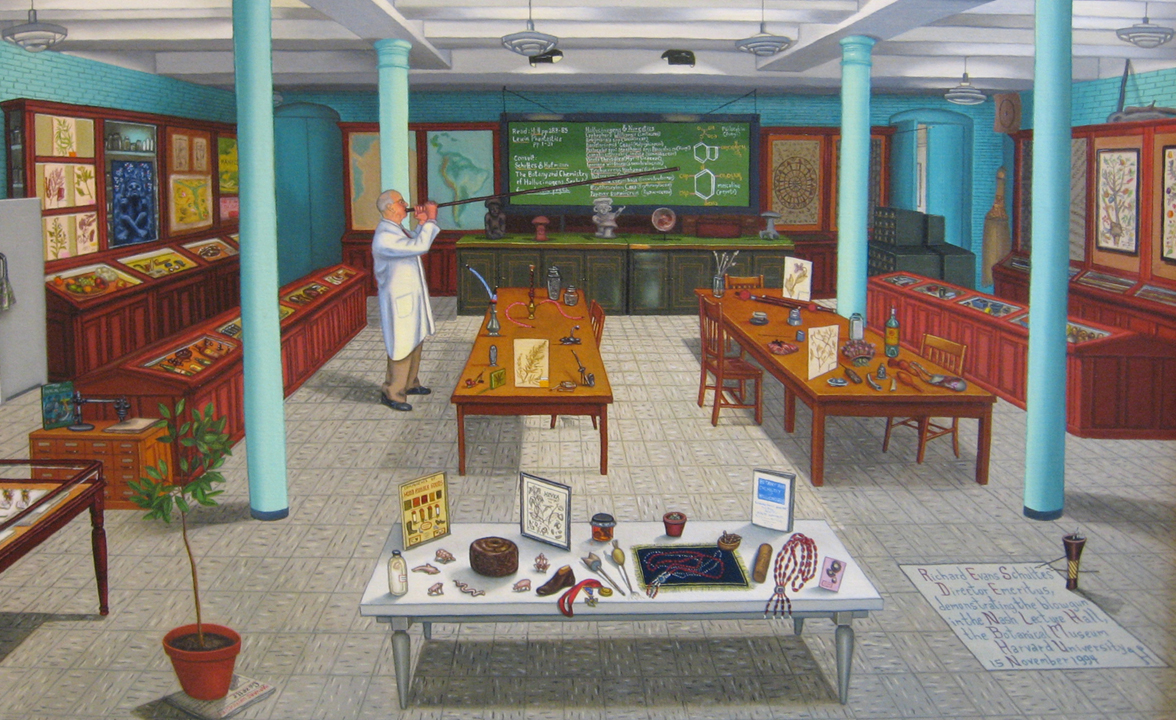
Dr. Schultes teaching in the Nash Lecture Hall
Painting by Hannah Barrett, November 1994
The caption in the tiles says, “Richard Evans Schultes, Director Emeritus, demonstrating the blowgun in the Nash Lecture Hall, the Botanical Museum, Harvard University, 15 November 1994.” Ethnobotanical explorer in lab coat? Check. Blowgun, darts and quiver? Check. Little potted cactus ($100 says Lophophora williamsii)? Check. More interesting details that I’ll leave for you, the reader? Check. I’m curious as to what molecule is diagrammed on the chalkboard…
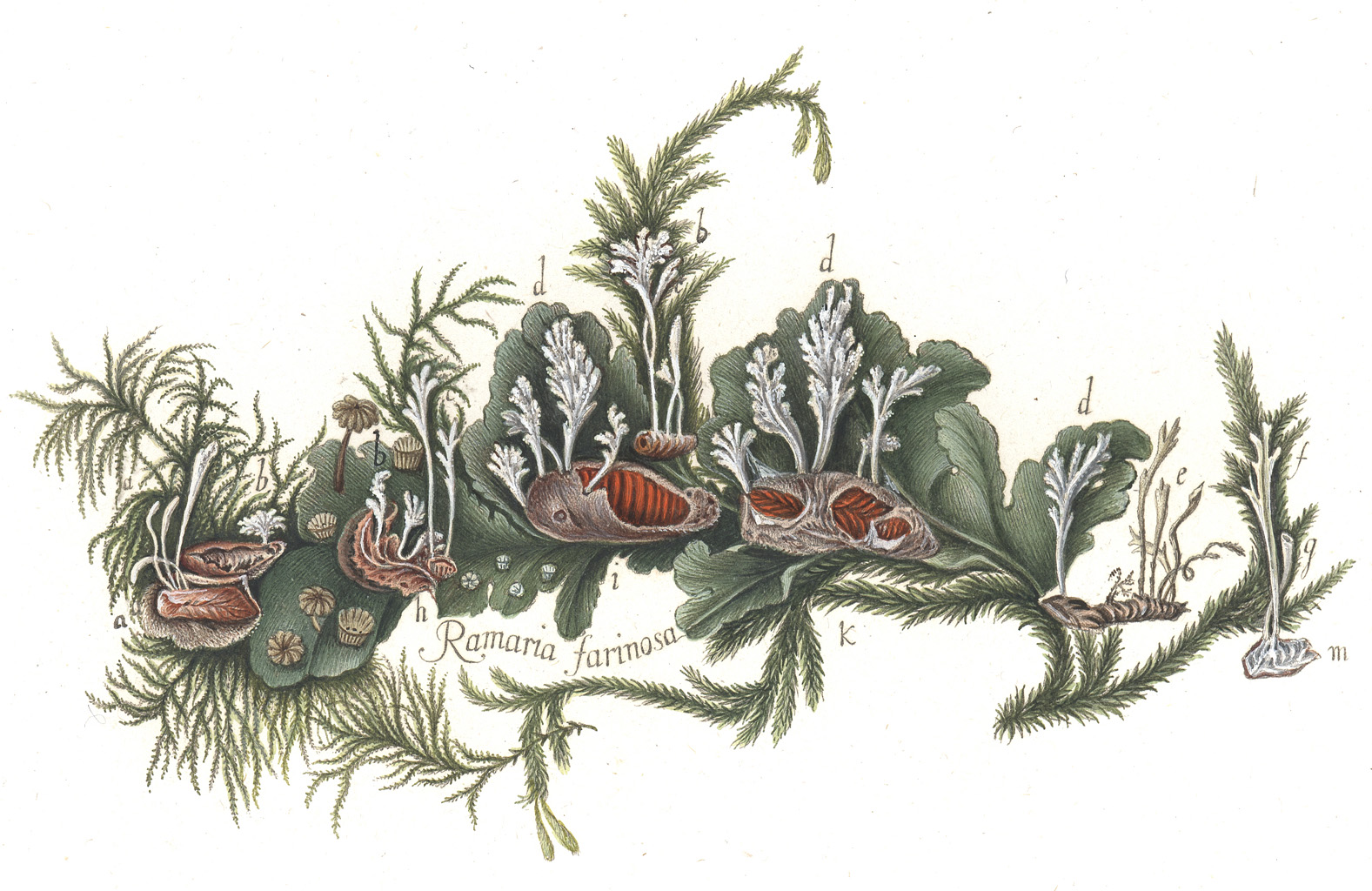
One last picture to end the post – from the book Beata Ruris Otia Fungis Danicis Impensa. Enjoy!
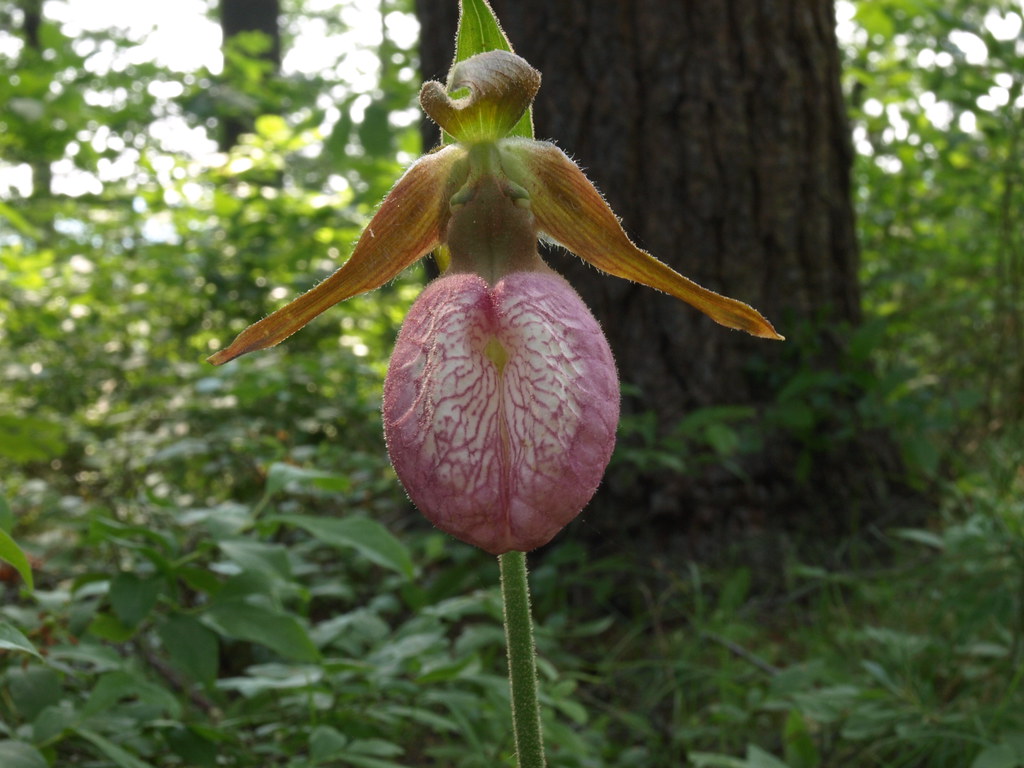
From the dottir’s place – they have one of the finest ladyslipper patches I’ve ever seen.
*

*
All thing must pass.

“Here’s an easy thing to say…” * (from one of my hands-down favorite books)
So – there’s Twitter – 140 character messages that bounce around the twitterverse. Within Twitter, there’s the notion of re-tweeting – echoing something someone else tweeted because it’s useful, amusing, etc. Originally, retweets were a user convention – you’d copy everything, prepend ‘RT’, add pithy comments of your own if you wanted, and send the message. It was so popular that a while ago Twitter formalized retweeting (a bit – you can still force the old style). The twitterverse also has bots – bits of software (running on hardware here, there and everywhere) that watch the global tweetstream for particular strings and retweet any message containing the target phrase. For example, Monsieur Poutine (@Poutine_Bot) will retweet any message he sees that contains a reference to the Quebecois delicacy.
An hour or so ago David Malki emitted “Poutine in Guam is great #experiment” * followed by ” RT @guamtweetbot: RT @Poutine_Bot: RT @malki Poutine in Guam is great #experiment” *. By using two keywords, he got two bots to retweet each other. That’s my kind of fun (sad, isn’t it) and I jumped in. It didn’t take me very long to catch on to something that would have been obvious if I’d thought about for a nanosecond – there’s good potential for the bots to start playing ping-pong with each other.
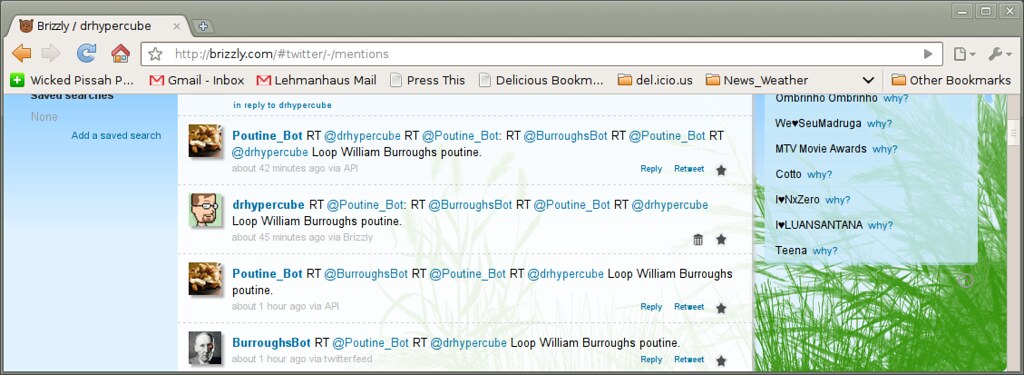
It appears that whoever coded the BurroughsBot considered the echo problem – he doesn’t resend like Monsieur Poutine will. I do draw the line at spending my evening looking for a romantic match for cheese-curd and gravy covered software, so I jumped in and retweeted to fill up this screen shot:
*
Through three cheese trees three free fleas flew.
While these fleas flew, freezy breeze blew.
Freezy breeze made these three trees freeze.
Freezy trees made these trees’ cheese freeze.
That’s what made these three free fleas sneeze. *