The future is already here — it’s just not very evenly distributed. – William Gibson *
Thanks to library digitization, access to the past is becoming much more widely distributed. The title of Paul Sholte’s paper says it all: “Using the past to manage for the future: contributions of early travel literature, free online, to African historical ecology”. From the Wired Science post that pointed me to the paper,
The writings of early travelers in Africa hold more than just descriptions of adventure and unspoiled wilderness. For conservationists they offer a view that can’t be seen any other way.
“Historical accounts are beginning to unravel our understanding of our environmental past,” said Paul Scholte, director of Kitabi College of Conservation & Environmental Management in Rwanda. “It would be an enormous waste not to use these writings, because we don’t have other sources of information from these periods. They open our mind on a number of issues where we lack the historical perspective.”
These old writings have been overlooked for too long, writes Scholte in an Aug. 26 African Journal of Ecology article. They were once limited to patrons of well-stocked libraries. But now, as digitization projects expand their holdings, anyone who can access the web can read the records of intrepid explorers such as the scholarly Heinrich Barth or the noble Adolf F. A. Heinrich, Duke of Mecklenburg. Sites like openlibrary.org, archive.org, biodiversitylibrary.org and books.google.com, are giving conservationists new opportunities to put the records to use.
It isn’t easy to know what an area looked like and which animals and plants were present 100 to 200 years ago. While pollen sample analysis gives some indication of plant communities, and an area’s oral tradition can be valuable, they are both incomplete pictures.
Compared to oral accounts passed down through generations, historical travel records are generally more detailed, more reliable and easier to date. *
One wonders what surprises might fall out of the intersection of digitization (especially of boring stuff – ledgers and the like), smart reader/translation software and data mining systems. I’m thinking mainly of social history here (Braudel/Annales), but that’s probably just a failure of imagination on my part.
Musical interlude: Not Great Men
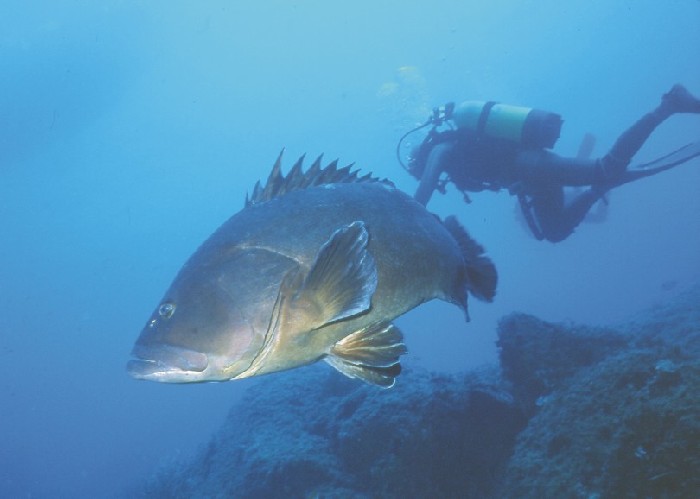
Dusky Grouper
Another example of mining the past for clues about ecological change: “Ancient art serving marine conservation” in Frontiers in Ecology and the Environment – hidden behind a paywall, but Stanford’s press release give a glimpse:
Fishing scenes were not uncommon sources of inspiration for coastal Mediterranean artists. Micheli and Guidetti found hundreds of Etruscan, Greek and Roman artworks involving sea creatures. Fish depicted in mosaics were often detailed enough to be recognizable as dusky groupers.
But unlike today’s animals, the groupers in Roman mosaics are depicted as being enormous – in one case, large enough to eat a fisherman whole.
Though the researchers pointed out that this example could be a case of artistic license, the depictions imply that groupers were large enough to be considered “sea monsters.” By comparison, groupers in unprotected waters today range from 50-60 centimeters (20-24 inches) in length.
Even more surprising, mosaics show men fishing for groupers with harpoons at the water’s surface. Today, this would be unheard of – modern sport fishermen spearfish groupers in deep water. But writings from the time corroborate this Roman view of the grouper as a shallow-water fish – the Roman writers Pliny and Ovid both describe angling for groupers from shore. *
Interesting – even if you discount some of the size difference as a classic and classical fish story, the behavior/biome change seems to shine through. I’ll keep my eyes peeled for additional examples of this sort of mining…